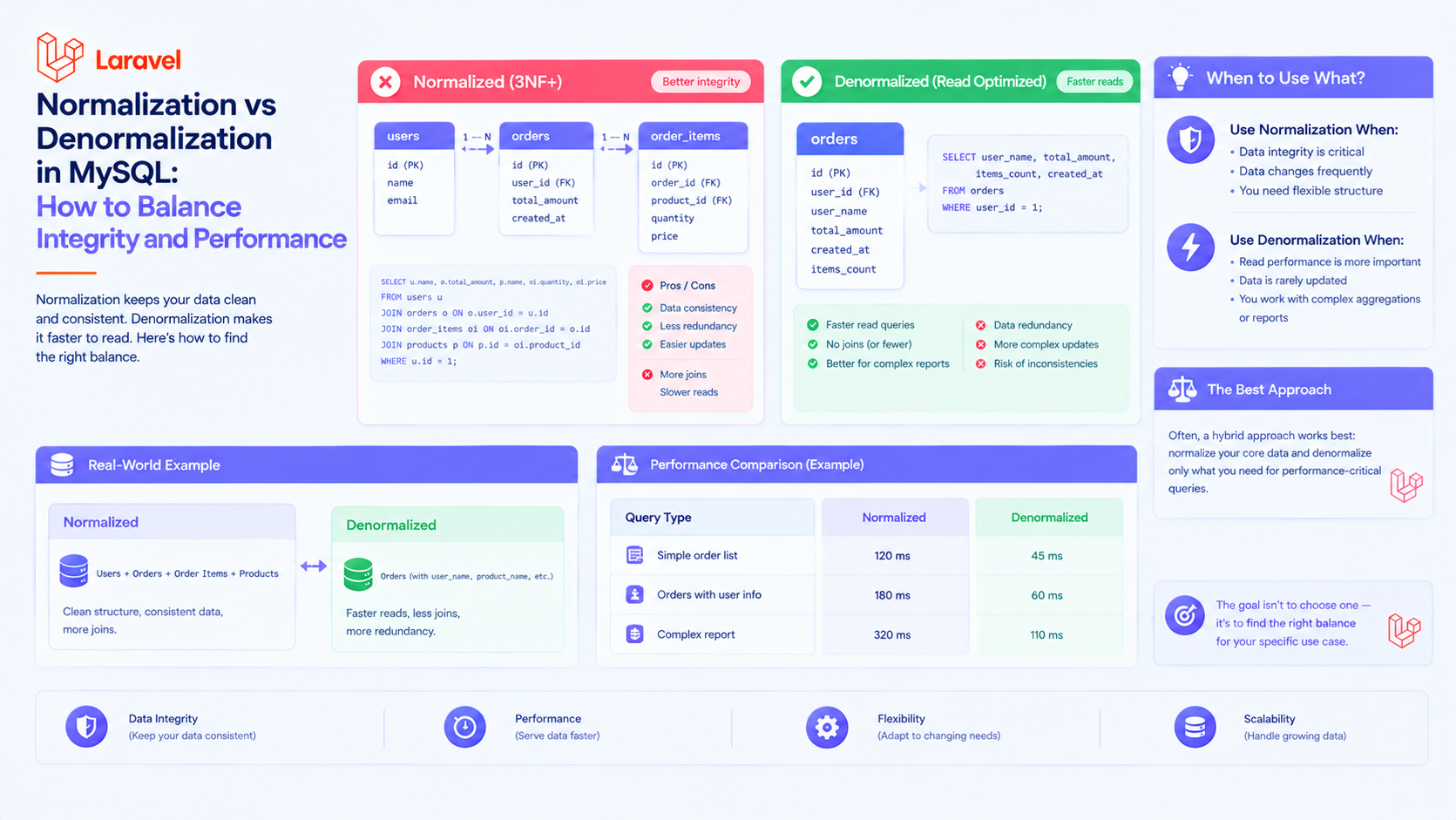
Normalization vs Denormalization in MySQL: How to Balance Integrity and Performance
In the world of relational databases, especially for powerful systems like MySQL, two key concepts are constantly weighed by architects: normalization and denormalization. This is not just dry theory, but a fundamental choice that determines your application's performance, scalability, and reliability. Let's break down what they are, when to use each, and how to find that perfect "golden mean."
What is Normalization? Perfect Order
Imagine you are organizing your digital archive. You wouldn't store all your documents in a single "Miscellaneous" folder. You would create a structure: "Work," "Personal," "Finances," and inside them—even more specific subfolders. Normalization in MySQL is the same process, but for data.
Normalization is the process of organizing data in a database to reduce redundancy and improve integrity. It follows a set of rules called "normal forms."
Main Goals:
- Eliminate Anomalies: Prevent situations where updating, deleting, or inserting data leads to inconsistency (e.g., updating a user's address in one place shouldn't require changing it in a dozen other records).
- Reduce Redundancy: Data is stored in a single instance. A country's name is not stored in every address row but in a separate countries table, referenced via a foreign key.
- Ensure Data Integrity: Using foreign keys (FOREIGN KEY) guarantees you cannot reference a non-existent record.
Levels of Normalization: From Chaos to Order
Normalization is a step-by-step process. Each subsequent normal form includes the requirements of the previous one.
1NF (First Normal Form): Atomicity of Data
- Rule: All values in columns must be atomic (indivisible).
- Prohibits: Arrays, lists, and other composite values in a single cell.
Example of a 1NF Violation: A table orders with a products field: "Laptop, Mouse, Keyboard"
Example of Conforming to 1NF: Create a separate order_items table:
2NF (Second Normal Form): No Partial Dependencies
- Rule: The table must be in 1NF, and every non-key attribute must be fully functionally dependent on the entire primary key.
- Solves Problems: When the primary key is composite, and some fields depend only on part of that key.
Example of a 2NF Violation:
Here, product_name depends only on product_id, not on the entire (order_id, product_id) pair.
Example of Conforming to 2NF:
3NF (Third Normal Form): No Transitive Dependencies
- Rule: The table must be in 2NF, and there should be no dependencies between non-key attributes (i.e., all non-key attributes must depend only on the primary key).
- Solves Problems: When changing one field requires changing another.
Example of a 3NF Violation:
Here, country_name depends on country_id, not directly on user_id.
Example of Conforming to 3NF:
BCNF (Boyce-Codd Normal Form):
- Strengthened 3NF: Every determinant (an attribute that functionally determines another) must be a candidate key (a potential primary key).
- Solves rare cases of overlapping candidate keys.
Normalization in Laravel: A Practical Implementation
Let's see how a normalized structure works in Laravel using a blog example.
Migrations for a Normalized Schema:
Eloquent Models with Relationships:
What is Denormalization? A Conscious Compromise for Speed
Now imagine you need to generate a summary report from all your folders every second. Navigating through dozens of subfolders becomes costly. You create a single "Ready Reports" folder where you pre-store copies of the necessary documents. This is denormalization.
Denormalization is the intentional introduction of redundancy into a database structure by combining tables or adding calculated fields to improve the performance of read operations.
Main Goals:
- Speed up queries: Reduce the number of JOINs and query complexity.
- Simplify the schema: Queries become easier to understand and write.
Example of Denormalization in Laravel:
Suppose we often need to display a list of posts along with the author's name. Instead of JOINing the posts and users tables every time, we can add an author_name field directly to the posts table.
- Table posts (denormalized):
Now the query SELECT title, author_name FROM posts executes instantly.
Another Example: Caching Aggregated Data
Let's say we frequently need to show a user's post count. In a normalized schema, we would do a COUNT() every time.
Denormalized approach — we add a posts_count field:
Pros of Denormalization: ✅ High speed for read operations (SELECT). ✅ Simplified queries, reduced CPU load due to fewer JOINs.
Cons of Denormalization: ❌ Data Redundancy: More disk space is used. ❌ Risk of Inconsistency: If a user changes their name, we must remember to update it in all posts in the author_name field. This complicates application logic. ❌ More Complex Write Operations (INSERT/UPDATE/DELETE): They become slower because data needs to be modified in multiple places.
So What Should You Choose? A Hybrid Strategy
In practice, pure forms are rare. Professionals use a hybrid approach based on specific requirements.
1. Start with Normalization Always begin your design with a normalized schema (at least up to 3NF). This is your "single source of truth," guaranteeing data integrity during development and through any changes.
2. Denormalize Consciously and Specifically Based on Metrics Don't denormalize "just in case." Do it only when you encounter real performance problems. Use monitoring and EXPLAIN ANALYZE in MySQL to find bottlenecks—the slowest queries with a large number of JOINs.
Typical Scenarios for Denormalization in MySQL/Laravel:
- Aggregated Data: Adding fields like total_likes, order_summary to a parent table to avoid calculating SUM() or COUNT() across millions of records every time.
- Wide Reporting Tables: Creating a separate denormalized table or view specifically for complex reports that are run infrequently.
- Read-Heavy Services: For parts of the application where read speed is critical (e.g., a news feed), you can sacrifice strict integrity for responsiveness.
- Counters: posts_count, comments_count, likes_count.
- Caching Calculations: reading_time, search_index.
3. Manage Consistency in Laravel If you choose to denormalize, you must ensure data consistency. Here are the main methods in Laravel:
- Model Events/Observers: Set up observers to automatically update denormalized data in related tables when the primary data changes.
- Database Transactions: Ensure atomic updates within a single transaction.
- Queues: For background updates of non-critical data.
Conclusion
Normalization and denormalization are not enemies but two tools in a developer's arsenal.
- Normalization is about integrity and reliability.
- Denormalization is about performance and read speed.
In Laravel, this balance is especially important thanks to the powerful Eloquent ORM. Start with a clean, normalized schema, use eager loading to optimize queries, and only add denormalized fields when truly necessary, always ensuring their consistency through Laravel's mechanisms.
Measure first, then optimize—and your application will scale efficiently!
#MySQL #Database #Normalization #Denormalization #Laravel #Eloquent #PHP #Backend #SoftwareArchitecture #LinkedIn