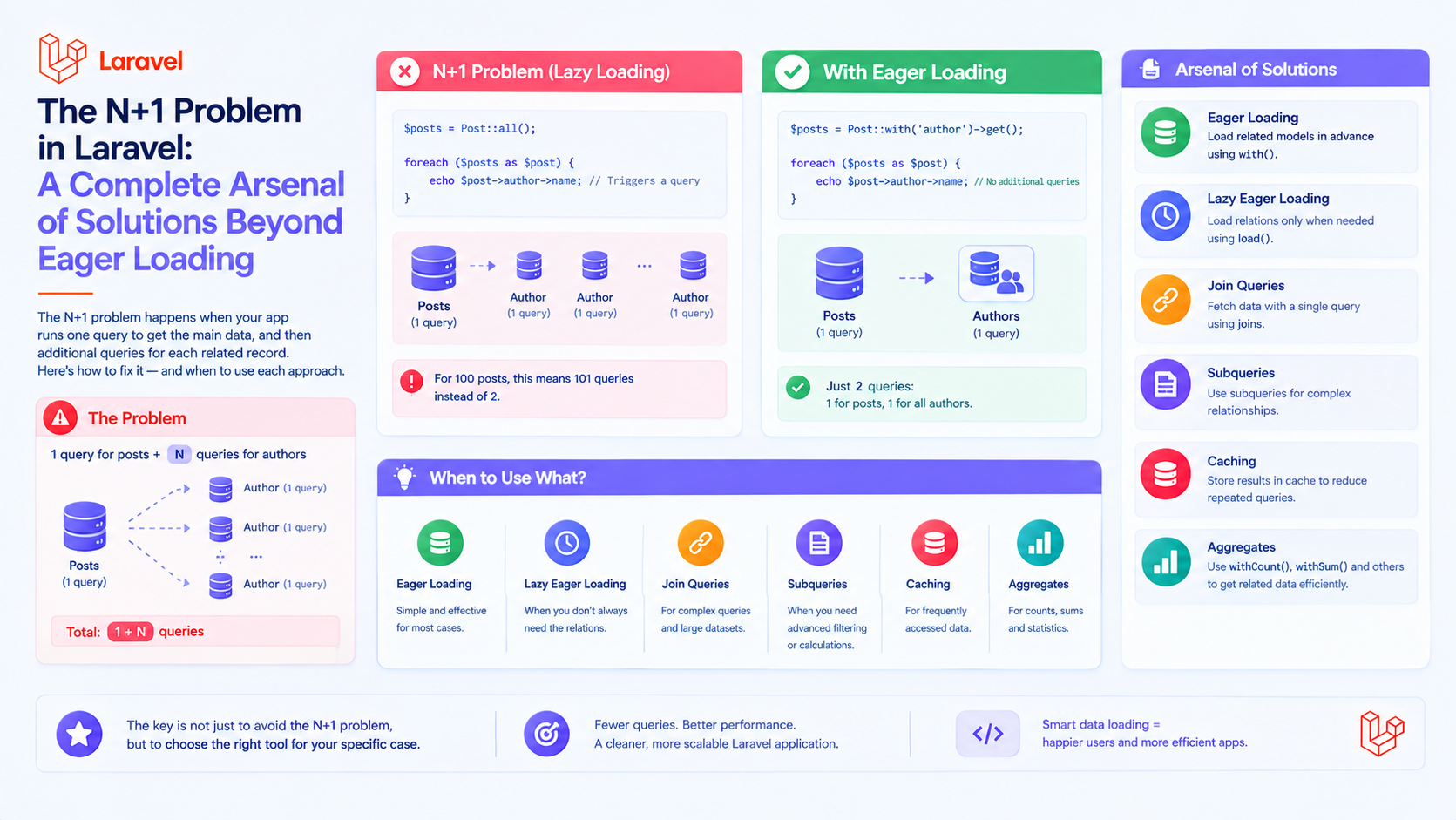
Il problema N+1 in Laravel: un arsenale completo di soluzioni oltre l'Eager Loading
Nell'articolo precedente abbiamo visto come l'Eager Loading risolve il problema N+1. Ma cosa succede se hai scenari complessi o hai bisogno delle massime prestazioni? Esploriamo TUTTE le possibili soluzioni.
🎯 Metodo 1: Eager Loading
La soluzione fondamentale che copre l'80% dei casi:
// Eager Loading semplice
$posts = Post::with('author')->get();
// Caricamento di più relazioni
$posts = Post::with(['author', 'tags', 'comments'])->get();
// Caricamento condizionale
$posts = Post::with(['author' => function($query) {
$query->select('id', 'name')->where('active', true);
}])->get();
🚀 Metodo 2: Joins
Quando hai bisogno solo dei dati delle tabelle correlate:
// Ottenere i post con i nomi degli autori in una singola query
$posts = Post::join('authors', 'posts.author_id', '=', 'authors.id')
->select('posts.*', 'authors.name as author_name')
->get();
// Usare direttamente nel template:
@foreach($posts as $post)
<p>Author: {{ $post->author_name }}</p>
@endforeach
⚡ Metodo 3: Has Many Through
Per relazioni profondamente annidate:
// Supponiamo che ci sia una catena: Country -> User -> Post
class Country extends Model
{
public function posts()
{
return $this->hasManyThrough(Post::class, User::class);
}
}
// Ora ottenere tutti i post di un paese con una sola query
$country = Country::with('posts')->find(1);
📊 Metodo 4: Lazy Eager Loading
Quando non sai in anticipo quali relazioni saranno necessarie:
$posts = Post::all();
// Caricare gli autori per la collezione già recuperata
$posts->load('author');
// O condizionatamente:
if ($someCondition) {
$posts->load('author', 'comments');
}
🎪 Metodo 5: Aggregati
Quando hai bisogno solo di conteggi o somme:
// INVECE DI QUESTO (N+1 query):
$posts = Post::all();
foreach($posts as $post) {
echo $post->comments->count(); // Query separata per ogni post
}
// FAI QUESTO (2 query):
$posts = Post::withCount('comments')->get();
foreach($posts as $post) {
echo $post->comments_count; // Il valore è già precaricato
}
🔥 Metodo 6: Raw Queries
Per le massime prestazioni in casi complessi:
$posts = DB::table('posts')
->leftJoin('authors', 'posts.author_id', '=', 'authors.id')
->leftJoin('comments', 'posts.id', '=', 'comments.post_id')
->select('posts.*', 'authors.name as author_name',
DB::raw('COUNT(comments.id) as comments_count'))
->groupBy('posts.id')
->get();
💾 Metodo 7: Viste del database
Per query molto complesse utilizzate frequentemente:
CREATE VIEW post_details AS
SELECT
p.*,
a.name as author_name,
COUNT(c.id) as comments_count
FROM posts p
LEFT JOIN authors a ON p.author_id = a.id
LEFT JOIN comments c ON p.id = c.post_id
GROUP BY p.id, a.name;
// Usare in Laravel come una tabella normale
$posts = DB::table('post_details')->get();
🏗 Metodo 8: Denormalizzazione
A volte è più semplice aggiungere dati ridondanti:
// Aggiungere un campo author_name alla tabella posts
$post = new Post();
$post->title = 'Example';
$post->author_name = $author->name; // Salvare una copia
$post->save();
// Ora ottenere il nome dell'autore senza JOIN:
$posts = Post::all(); // Nessun N+1!
📝 Metodo 9: Scopes con Eager Loading
Creare scope riutilizzabili:
class Post extends Model
{
public function scopeWithRelations($query)
{
return $query->with(['author', 'comments' => function($q) {
$q->latest()->limit(5);
}]);
}
}
// Usare ovunque:
$posts = Post::withRelations()->get();
🎯 Quando usare cosa?
- Eager Loading — per la maggior parte dei casi
- Joins — quando hai bisogno solo dei dati delle tabelle correlate
- Has Many Through — per relazioni profonde
- Aggregati — per conteggi e somme
- Raw Queries — per le massime prestazioni
- Viste del database — per query molto complesse
- Denormalizzazione — per dati richiesti frequentemente
🔍 Come trovare le aree problematiche?
// In AppServiceProvider
public function boot()
{
if (app()->environment('local')) {
DB::listen(function ($query) {
if (str($query->sql)->contains('where `id` in')) {
Log::warning('Possible N+1 detected: ' . $query->sql);
}
});
}
}
Conclusione: L'Eager Loading è un'ottima soluzione, ma non è l'unica. Scegli l'approccio in base all'attività specifica e ai requisiti di prestazioni.